Air tours

Sea tours

Safari tours

Bus tours

Nile Cruise

Contacts

Sharm el Sheikh tours, Excursions in Sharm el Sheikh

Guide to Sinai, its history, geography, deserts and Sightseeings

History of Sinai
About twenty million years ago, Egypt , Sinai and the Arab peninsula were a united block. Then a huge terrestrial devastations led to the separation of the lands and the southern Sinai peninsula remained isolated, giving rise to two large gulfs: the gulf of Suez, which maximum depth is barely 95 meters and gulf of Aqaba to the east, which instead reaches a depth of 1800 meters.

Geography of Sinai
Sinai is a meeting point of continents and acting like a bridge between seas! The total area of Sinai is 24000 square miles and thus represents 6% from the total area of Egypt . The great seismic activity of the past and the tremendous eruptive phenomena have given Sinai its characteristic imprint. Mountains here are not that high but very much important to the history. The most important peaks are the Moses' mountain 2285 meters & St. Catherine mountain 2642 meters - the highest in Egypt . The west coast that stretches from Sharm-el-Sheikh to Ras Mohamed goes as far as Taba.

Sinai Peninsula is especially beautiful with its landscapes, marked by mountains, plains, valleys and beautiful beaches, while the sea offers coral reefs, unique kinds of fish and fascinating nature. Sinai draws visitors from around the world for all kinds of tourism: leisure, history, culture, religion, sports and even therapy.

Sinai has six protectorates, the oldest of which is Ras Mohamed. As now Egyptian government pays much attention for development on Sinai and at the same time protects the special environments of Sinai 6 places on Sinai were declared to be a protected area, they are: Abu Galum, Al Zaranik, Nabaq, Ras Mohamed, Saint Catherine & Taba.

Abu-Galum protected area – 88 km up the coast, just past the city of Dahab , is the Abu Ghalum Managed Resource Protected Area, the smallest of the South Sinai protectorates. Abu-Ghalum has hiking trails going through the rocky desert hills and gravel beaches leading to rarely visited coral outcrops. Dahab, part of the protectorate, has its share of renowned dive sites like Blue Hole and The Canyon.

The St Catherine's covers an area of 5,750 squared kilometres, or 20 percent of South Sinai . It contains Egypt 's highest mountain: St Catherine's (2,624 m), as well as Mount Sinai -- held sacred as the place where Moses received the Ten Commandments, Mount Serbal , Mount Um Shomer and Mount Tarbush . The mountains are composed of igneous rock between 500 and 1,000 million years old - one of the most violent periods of activity took place in the Pre-Cambrian era about 800 million years ago. The towering granite crags overlooking St Catherine's Monastery are some of the oldest in the world.

The mountains enclose wadis (dry valleys) studded with acacias and other vegetation, while higher in the rocks are clefts where water gathers seasonally, forming pools and nurturing the variety of herbs and desert shrubs from which the Bedouin draw nutritional supplements and medicinal remedies. Fortyfive percent of all the plants in Egypt are found in Sinai: of these 320 species 19 are unique to Sinai (including a native primrose) and more than 100 have a medicinal use.

Wildlife includes the Nubian ibex, Dorcas gazelle, Striped hyena, Red fox, Fennec fox, Wolf, Wild cat, Sinai leopard, Rock hyrax, Rodents, Geckos, Skinks, Hedgehogs and Hares. There are 46 reptile species, 15 of which are found nowhere else in Egypt , among them two species of snake, the Sinai banded snake and the Innes cobra, which are found only in the National Park. There are 150 species of migrating birds, including about 40 raptor species. Sinai is also home to the smallest butterfly in the world, the Sinai Baton Blue, half the size of a fingernail and confined for eternity to the top of one mountain since it cannot live below a certain altitude, and its tiny wings cannot carry it as far as the next peak.

There are more than 500 historical sites and buildings in Sinai, dating from the round stone nawamis built about 4,000 BC to structures from the Bronze Age and Nabatean, Byzantine and Islamic periods. There are abundant foundations of tombs, houses, storehouses, animal traps, and evidence of copper smelting. The sites have yielded Bronze Age jewellery and amulets and tools and pottery from all ages. In 2002 UNESCO declared St Catherine's a World Heritage Site.

The Ancient Egyptian kings went to Sinai for gold, turquoise and copper and the remains of their mines can still be seen. Just before Abu Zenima, a turn off the main road leads past the manganese mines to Serabil El Khadim. There are some abandoned turquoise mines and ruins of a rock cut temple of the 12th dynasty dedicated to the goddess Hathor who was known locally as the mistress of the turquoise. Pharaohs of later dynasties erected many stellaes which are still at the site commemorating their mining expeditions to Sinai.

Serabit Al-Khadem is known not for the Temple of Hathor and the turquoise mines alone, but also because it was here that a mysterious script was found, a script that resembles hieroglyphics and appears to have evolved in Sinai. British archaeologist Flinders Petrie concluded that it was invented by a Semite who worked in the turquoise mines in about 1400 BC, using a linear script on the hieroglyphic model. His compatriot, the linguist Sir Alan Gardiner, noted the remarkable fact that at least six of the signs presented appearances that unmistakably corresponded to the meanings of letter-names belonging to the Hebrew and Greek alphabets. Even more convincing of cultural overlapping, one group of four letters -- repeated several times -- could read as Ba'alat, or 'the mistress', the female Ba'al, the name inevitably given by Semites to the Egyptian goddess Hathor (see insert). This confirmed that the inventor was a Semite who actually worked in the turquoise mines.

Let us now return to the Temple of Hathor at Serabit Al-Khadem on a 755-metre high plateau inland from Abu Zeneima. It was built in an area particularly rich in turquoise, a semi-precious stone much in demand by the Ancient Egyptians but of which there is no trace today. Although the earliest evidence of mining dates to an early period, it was not until the Middle Kingdom, especially between 1790 and 1778 BC, that a permanent Egyptian presence was established there. The Pharaoh Senusert developed the site of an earlier rock-hewn shrine known as the Cave of Hathor in which the miners may have placed a statue of their patron goddess. A portico and open court were constructed in front of it to form a temple, from which position rocky trails lead to several small turquoise mines. Naturally there was a residential area for the priesthood, and some of the inscriptions leave no doubt that miners themselves sometimes served as volunteer priests.

Expeditions set out from Egypt every three or four years -- annually in times of special need for the precious stone -- under the command of important officials, some of whom claimed to be "an acquaintance of the king". The miners mounted rocky trails where they left graffiti of boats and hieroglyphic inscriptions some of which refer to the goddess Hathor as "the lady of the turquoise". They worked each mine rapidly, and when the source was exhausted went in search of new veins, but not before first making offerings to their patron goddess whose temple was successively enlarged and adorned.

During the 18th Dynasty, in about 1580 BC, the barracks were enlarged and the Temple of Hathor received attention from Queen Hatshepsut and Tuthmose III. Its orientation was changed when another shrine, dedicated to Sopd, a god of the Eastern Desert , was added at its southern end. By this time the structure did not resemble a traditional Egyptian temple at all. Courts, pylons and some dozen chambers with roofs supported on pillars can be identified.

This was a period of the greatest mining activity in Sinai, and because the Bedouins, who always resented the Egyptian presence, became more troublesome, a small Egyptian garrison was set up to keep watch over their movements. Why the local community should have attacked the miners is difficult to say; perhaps it was for no more than a meagre booty. Nevertheless armed pursuits were made, and records of Egyptian successes were frequently presented in triumphal reliefs inscribed on the rocks -- possibly exaggerated portrayals of fairly inconsequential incidents.

The mines around Serabit Al-Khadem, along with the now destroyed mines of Wadi Maghera, represented Egypt 's main source of this popular stone, and mining was clearly an arduous task. The men had to crawl through narrow horizontal openings at ground level. The larger, grander mines could hold about 50 workers and in the hot months conditions were almost unbearable, as was described in a text dating from the 12th-Dynasty reign of Amenemhet III. One of his officials was almost in despair when he experienced a desert that " ...burned like summer, the mountain was on fire... ", but, he continued, he fortunately survived and recorded that his mission was successful.

When Flinders Petrie studied the temple in 1905 he removed many of the smaller stelae and statues; deciding to leave only the larger stelae in situ. These -- taller and narrower than most Egyptian stelae -- appear to have been erected at random. Some of these were also later removed, others scattered, and many reused and placed in different positions.

The Temple of Hathor leaves one with a somewhat confused impression of its layout. Consequently, the very suggestion of sorting out these various elements and "upgrading" the temple is unrealistic. The site should be left as it is, and it is suggested that a visitors' centre be built at the foot of the plateau and travellers, if physically able, left to make a strenuous 15-minute climb up the stony trail of Rud Al-Ayr over dry, jagged rocks to the Temple of Hathor . This is not a tourist-friendly site, and neither should it be.

The great Via Maris, that connected the Nile Valley with Mesopotamia , followed the Mediterranean coastline of Sinai. The Roman and Nabateans used an east west desert route across Sinai, a road that later acquired the name of Darb el Hajj, the pilgrims' way from Egypt to Mecca .

Al-Nawamis burial chambers - Al-Nawamis means mosquito nets in Arabic. It lies about 60km from Dahab and around 70km from the Monastery of St Catherine. We took the Kurry Valley road, 35km from Al-Hododa sand dune. The small, circular, stone buildings were built around 4,000 BC between the Bronze and Heliolithic ages. There are other historical sites that might be Byzantine burial places.

The chambers were built from sand stones with rocks placed in circles. they have only one opening, a small door, just enough to squeeze a dead body, and a roof to protect the buried from weather conditions. They are built looking west, the direction of the sunset. "They believed that when the day dies and the sun sets, so does the human being."

Nabateans were clever merchants who exploited their position at the nexus of several trade routes though they didn't maintain clear-cut boundaries with their neighbours. Nabatea is believed to have occupied the border area between Syria and Saudi including current-day Jordan and which extended to cover the Sinai Peninsula . Trade routes and the origin of goods were considered a matter of national security; revealing any was an act of high treason. Along their secretive trade routes they maintained garrisons and stations to rest and replenish with food and water supplies, one of which is the archaeological site known as the " Nabatean Village ". Nabatean civilisation reached its zenith with the carving of the elusive city of Petra (current-day Jordan ) around the first century BC. But civilisations have all been characterised by rises and falls and Nabateans were no different. Roman Emperor Trajan waged a ruthless war that ended with annexing the Nabatean Kingdom as part of the greater Roman Empire . The splendorous city of Petra was reduced to the Roman province of Arabia Petraea .

From Gabal Searu, along a wide wadi extending as far as Abu Sayla not more than 40 metres into the trail, you will find a large boulder with inscriptions left by Nabataeans - tribes of the Arabian peninsula . It was obviously a trade route in ancient times, and the inscriptions were made by passing Nabataean caravans travelling to and from Sinai, Palestine and Petra , in Jordan . The inscriptions, are details of the size of a caravan, its number of travellers and the merchandise they carried. The inscriptions served as a record of the caravan, such that if something should happen to it - an attack by pirates, for example - other caravans would be able to retrieve the cargo and save the merchants.

To the casual eye Sinai is mountainous, arid and forbidding. The land is unsuitable for farming and little rain falls. Blistering heat by day and bitter cold by night enhance the outward appearance of desolation.

Sinai activities
Sinai now is an exciting place to enjoy a hobby or embark on a new one. South Sinai is a moonscape of granite mountains; the monastery of saint Catherine & Moses mountain are the most famous religious places of the area.
Other favourite activities include star gazing by amateur astronomers, camel trips, quad-biking safaris, horse riding in the desert and many others.

The recreation spot closest to the mainland is near Ras-el-Sudr. This place is perfect for wind surfing because there are no stones in the sand and no coral reefs. For those looking for some action, due to its strong wind, Dahab is equally famous for its water sports especially windsurfing. The city beats the fame of Ras Sedr and El-Gouna in this particular sport. Windsurfing is a common feature in Dahab.

On Sinai a city of peace Sharm-El-Sheikh is situated - with its beautiful beaches, nice weather all the year around and quietness. Around 15 km far from Sharm-El-Sheikh is situated the most beautiful dive site all over the world - the National park of Ras Mohamed . Another cities such as Dahab, Nuweiba and Taba are also situated along the Aqaba gulf.

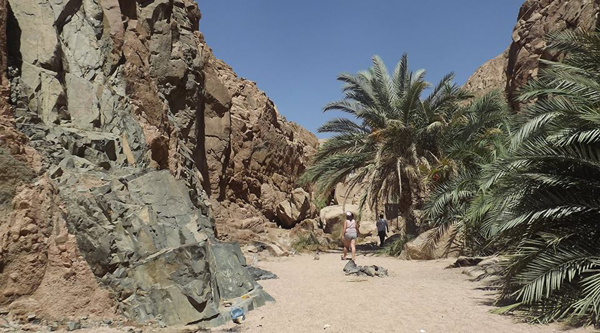
There are 13 canyons in Egypt and all in Sinai, the most popular among tourists are Coloured canyon & White canyon. Al-Arda canyon, or the double canyon, lies 90km away from Dahab. The name Arda refers to a plant there, the only place in Sinai where it can be found. The plant changes colour during the summer into blue, sometimes grey, and is known amongst the Bedouins as a herbal medicine that cures asthma.

Al-Hododa, the biggest and tallest sand dune in Sinai. The name Al-Hododa came from the root word, to tear down. "The sand is very soft, and the wind is very active in this area. So the dune changes frequently from one place to another according to wind speed. The sand comes down during this process. That's where the name came from," Al-Hododa is 33km away from Dahab by GPS.

There are many oases as well, one as Ain Umm Ahmed oasis never lacks water: a replenishing spring flows from a narrow creek between two mountains. Each household has its own pump to draw ground water for use in cooking and irrigation and for drinking and bathing.

Coloured canyon


Nabq safari


St. Catherine monastery


Serabit el-Khadim


Sunrise on the pick of Mount Sinai


Cave of Hathor


Glass bottom boat


Water skiing


Quad-biking


Ras Mohammed National park


Cairo | Luxor | Guestbook | Home | Nile Cruise | Climate | Activities
Copyright 2009 © Sharm Club. All rights reserved.